Write a C# Sharp program to sort a list of elements using Heap sort ?
- برمجة سي شارب
- برمجة
- 2021-05-29
- ahmadghneem
Write a C# Sharp program to sort a list of elements using Heap sort ?
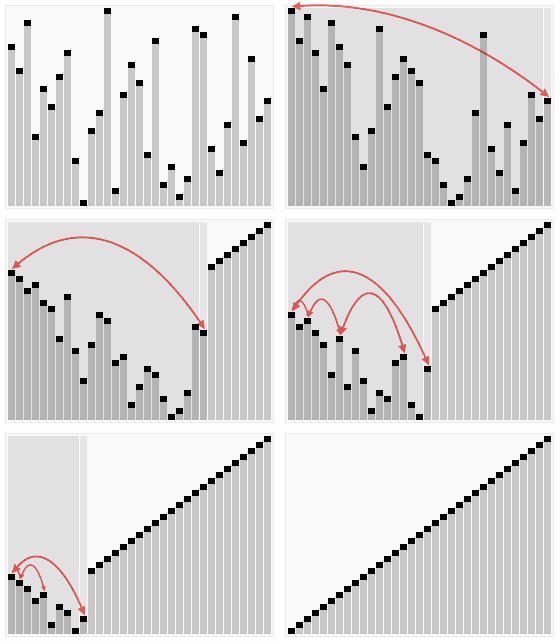
In computer science, heapsort (invented by J. W. J. Williams in 1964) is a comparison-based sorting algorithm. Heapsort can be thought of as an improved selection sort: like that algorithm, it divides its input into a sorted and an unsorted region, and it interactively shrinks the unsorted region by extracting the largest element and moving that to the sorted region. The improvement consists of the use of a heap data structure rather than a linear-time search to find the maximum.
Although somewhat slower in practice on most machines than a well-implemented quicksort, it has the advantage of a more favorable worst-case O(n log n) runtime. Heapsort is an in-place algorithm, but it is not a stable sort.
الأجوبة
using System;
namespace Heap_sort
{
	public class MainClass
	{
		public static void Main (string[] args)
		{
			int[] mykeys = new int[] {2, 5, -4, 11, 0, 18, 22, 67, 51, 6};
			//double[] mykeys = new double[] {2.22, 0.5, 2.7, -1.0, 11.2};
		    //string[] mykeys = new string[] {"Red", "White", "Black", "Green", "Orange"};
			Console.WriteLine("\nOriginal Array Elements :");
			printArray (mykeys);
			heapSort (mykeys);
		    Console.WriteLine("\n\nSorted Array Elements :");
			printArray (mykeys);
            Console.WriteLine("\n");
		}
		private static void heapSort<T> (T[] array) where T : IComparable<T>
		{
			int heapSize = array.Length;
			buildMaxHeap (array);
			for (int i = heapSize-1; i >= 1; i--)
			{
				swap (array, i, 0);
				heapSize--;
				sink (array, heapSize, 0);
			}
		}
		private static void buildMaxHeap<T> (T[] array) where T : IComparable<T>
		{
			int heapSize = array.Length;
			for (int i = (heapSize/2) - 1; i >= 0; i--)
			{
				sink (array, heapSize, i);
			}
		}
		private static void sink<T> (T[] array, int heapSize, int toSinkPos) where T : IComparable<T>
		{
			if (getLeftKidPos (toSinkPos) >= heapSize)
			{
				// No left kid => no kid at all
				return;
			}
			int largestKidPos;
			bool leftIsLargest;
			if (getRightKidPos (toSinkPos) >= heapSize || array [getRightKidPos (toSinkPos)].CompareTo (array [getLeftKidPos (toSinkPos)]) < 0)
			{
				largestKidPos = getLeftKidPos (toSinkPos);
				leftIsLargest = true;
			} else
			{
				largestKidPos = getRightKidPos (toSinkPos);
				leftIsLargest = false;
			}
			if (array [largestKidPos].CompareTo (array [toSinkPos]) > 0)
			{
				swap (array, toSinkPos, largestKidPos);
				if (leftIsLargest)
				{
					sink (array, heapSize, getLeftKidPos (toSinkPos));
				} else
				{
					sink (array, heapSize, getRightKidPos (toSinkPos));
				}
			}
		}
		private static void swap<T> (T[] array, int pos0, int pos1)
		{
			T tmpVal = array [pos0];
			array [pos0] = array [pos1];
			array [pos1] = tmpVal;
		}
		private static int getLeftKidPos (int parentPos)
		{
			return (2 * (parentPos + 1)) - 1;
		}
		private static int getRightKidPos (int parentPos)
		{
			return 2 * (parentPos + 1);
		}
		private static void printArray<T> (T[] array)
		{
			foreach (T t in array)
			{
			    Console.Write(' '+t.ToString()+' ');
			}
		}
	}
}
أسئلة مشابهة
القوائم الدراسية التي ينتمي لها السؤال